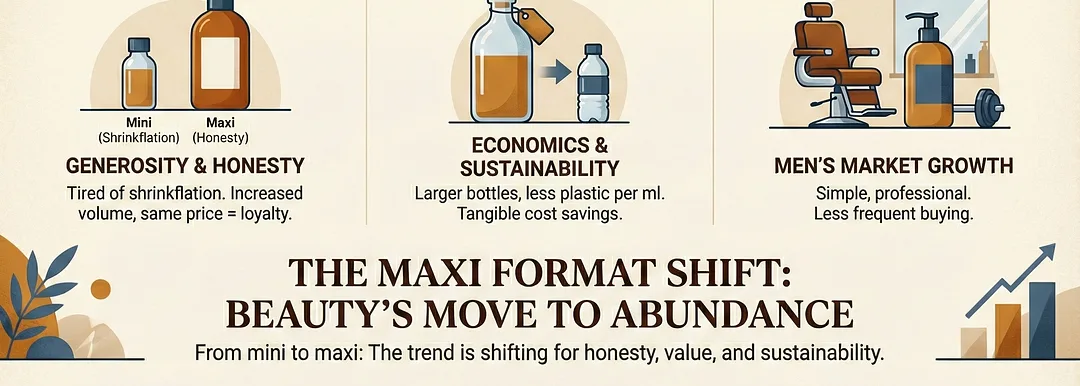
Just a few years ago, the beauty market was clearly on the side of mini formats. Travel sizes, discovery kits, small bottles made perfect sense in a world obsessed with mobility, flexibility, and younger consumers constantly on the move. But in 2025, the trend is shifting in the opposite direction. Maxi formats — large jars, pump bottles, liter and even multi-liter sizes — are becoming one of the fastest-growing segments in body care. And this shift is anything but random.
1. The generosity effect and fatigue from shrinkflation
Consumers are increasingly tired of shrinkflation — when the product gets smaller while the price stays the same. This practice is no longer subtle. Against this backdrop, brands that move in the opposite direction stand out. A clear example is Harry’s in the US, which increased the volume of its shower gel from 473 ml to 532 ml without raising the price. This doesn’t feel like a promotion; it feels like honesty. And honesty is a powerful loyalty driver.
2. Packaging economics and practical sustainability
Maxi formats are not just a gesture of generosity — they are simple math. Keeping the same bottle shape while increasing volume reduces the amount of plastic per milliliter of product. That means a lower environmental footprint. For families, it’s a cost-effective choice. For brands, it’s a tangible step toward sustainability without greenwashing.
3. The men’s market as a key growth driver
Men tend to choose products based on straightforward logic:
simple, convenient, less frequent repurchasing, one big bottle instead of several small ones.
There’s also a perception of professionalism. Large pump bottles are associated with gyms, barbershops, and professional environments. This association strongly fuels the growth of maxi packaging in men’s care.
4. Maxi sizes as a new form of luxury
Interestingly, large formats have entered the premium segment as well. Industry experts refer to this as the “aesthetics of abundance.” Think of Diptyque’s three-wick candles or La Mer’s oversized cream jars priced in the thousands. Here, the key factor isn’t savings — it’s symbolism.
An XXL hero product feels like a bold, confident purchase. It amplifies the gift effect and creates an emotional narrative of celebration and abundance. For brands, it’s a powerful desirability tool.
5. Inflation, pricing, and consumer psychology
Over the past year, prices in body care categories have risen by an average of 5%. Brands need to justify these increases, and one effective strategy is offering more volume. “More expensive, but more product” is psychologically easier to accept than a simple price hike.
6. Limitations and the other side of the trend
Despite strong growth, maxi formats won’t replace minis entirely. They’re impractical for sports, travel, and small living spaces.
The market is moving toward format diversification: XXL for home use and smaller sizes for mobility. Not either-or, but both.
At a recent beauty trade show, I came across three-liter shampoo bottles. Instead of feeling excessive, they felt like an honest response to the moment we’re living in — a shift away from constant movement toward stability and substance.
In the Open Beauty Hub community, we continue to analyze these shifts not as fleeting trends, but as reflections of deeper changes in consumer behavior, economics, and the psychology of choice.