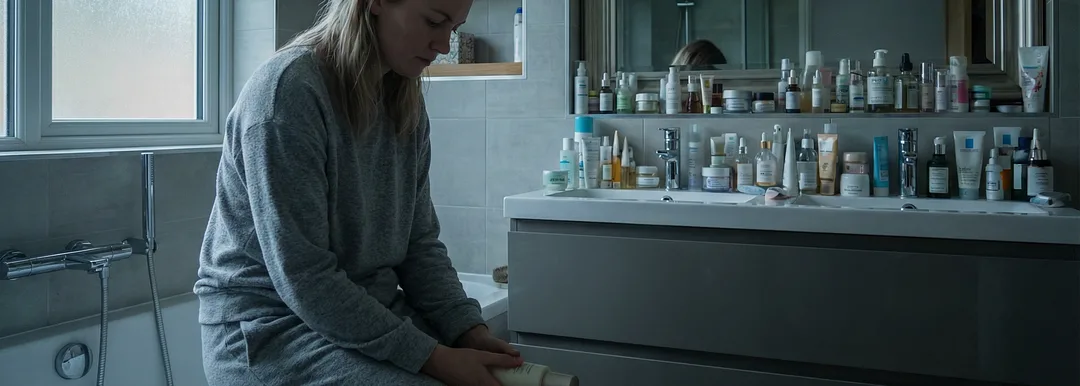
Once upon a time, skincare was a small ritual. Now it often feels like another item on a to-do list — wedged between work, emotional housekeeping, sleep struggles, and the endless attempt to “keep up.” In 2025, the term beauty burnout appears more and more in research and consumer behavior reports. It’s not laziness. It’s not a lack of discipline. It’s a real psychological and physical phenomenon.
People are exhausted by routines that demand too much time, too many products, and too many decisions.
Why beauty burnout is rising
1. Too much choice
When skincare meant three products, things were simple. Today every shelf is an avalanche of serums, toners, acids, cleansers, balms, boosters, essences, masks, and mystery textures.
Choice was supposed to offer freedom. Now it creates anxiety. The brain gets tired of making cosmetic decisions just as much as professional ones.
2. Cognitive noise everywhere
Social media algorithms feed us contradictory advice 24/7.
One expert says “retinol daily,” the next says “never.” One blogger is obsessed with acids; another warns they’ll destroy your barrier.
Consumers end up thinking: Do I do more? Less? What actually works? What’s safe for my skin?
Eventually, they shut down. That shutdown is beauty burnout.
3. Procedure fatigue
In the last decade we normalized the constant cycle of lasers, microneedling, acids, resurfacing, peels. But skin doesn’t always want permanent correction mode. Barriers weaken. Sensitivity climbs. A feeling appears: my skin is tired of everything.
Beauty burnout is emotional and physiological at once.
4. A new relationship with time
Trends in 2024–2025 turned toward calm: slower rituals, sensory textures, neurocosmetics.
People no longer want “more steps.” They want presence.
Skincare is shifting from a project to a pause.
How beauty burnout shows up
• craving simpler routines
• irritation toward “complicated” products
• loss of joy in self-care
• skepticism toward beauty marketing
• desire to “use nothing for a week”
• heightened sensitivity after regular products
It’s emotional overload paired with an overwhelmed skin barrier.
Where the market is moving
Reports from Euromonitor and Mintel show a clear pivot:
1. Optimization, not layering
Formulas become multifunctional — one product replacing three or four.
Hydration, barrier support, anti-aging, postbiotics — all in one cream.
2. Minimalism with credibility
Not minimalism for aesthetics, but minimalism for efficiency.
Top performers now include CeraVe, La Roche-Posay, Typology — brands built on clarity, not complexity.
3. Sensory and emotional care
Neuro-aromas, calming textures, gentle massages — skincare that regulates the nervous system.
4. Anti-perfectionism
Filters and polished Instagram skin are losing their power.
Honest texture and normal imperfections feel more real — and more human.
How to recover from beauty burnout
1. Shrink your routine to three steps
Cleanser — cream — SPF. The base that always works.
2. Remove the noise
Serums and actives only for specific needs, not “because everyone uses them.”
3. Reset the barrier
Ceramides, cholesterol, fatty acids, ectoin, betaine — a restoration cocktail.
4. Bring back tactility
1–2 minutes of gentle massage while applying cream.
It lowers stress and boosts microcirculation.
5. Allow yourself a pause
Routines should never be punishment. Skincare becomes healing only when it stops demanding.
Beauty burnout isn’t weakness. It’s adaptation — a natural response to years of overstimulation. And now, finally, the industry is shifting toward something softer, wiser, and more sustainable. In the Open Beauty Hub community, we explore skincare without pressure or noise — routines that respect your biology, your pace, and your emotional landscape.