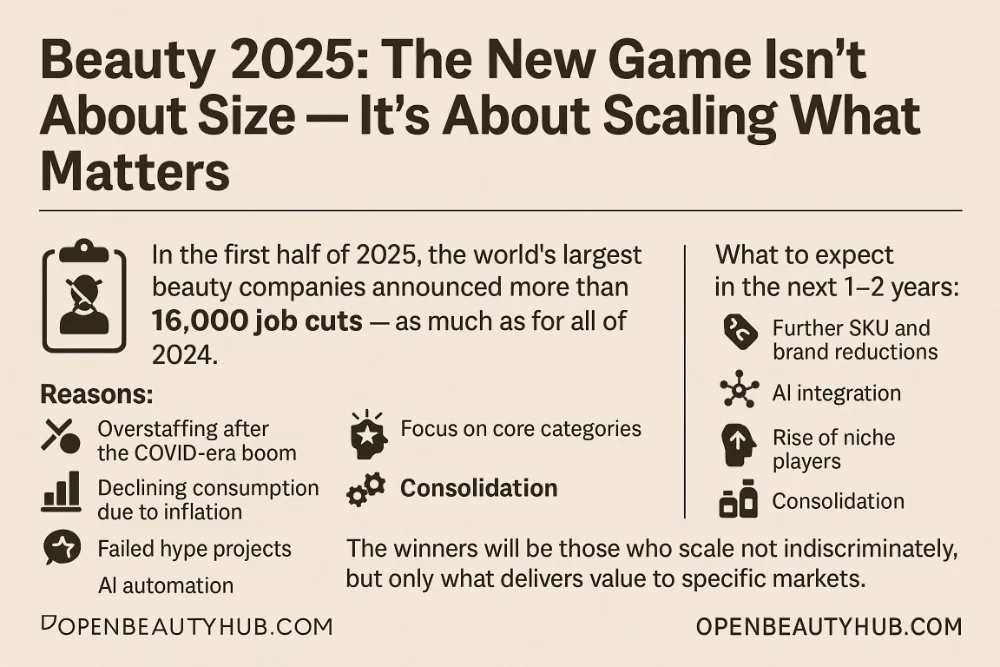
In the first half of 2025, the world’s largest beauty companies announced more than 16,000 job cuts — a number matching the total for all of 2024. This isn’t panic or collapse. It’s surgery. A “strategic pruning” — a term increasingly heard in boardrooms. Excess processes, outdated projects, and overloaded structures are being cut away to leave only what truly works.
How we got here
After record growth in 2019 and a pandemic-fueled skincare boom, companies expanded aggressively: hiring en masse, launching new lines, acquiring brands, and investing in trendy tech — from metaverse experiences to AR makeup. But by 2022, the market had plateaued. Consumer spending declined, competition intensified, and not every digital experiment delivered a real return.
Estée Lauder plans up to 7,000 job cuts by 2026 — its biggest reduction in nearly a decade.
Procter & Gamble will remove 7,000 office positions.
Unilever has already eliminated 6,000 roles.
Shiseido shut down its metaverse unit, offered early retirement to 1,500 employees in Japan, and began restructuring in the Americas.
Unlike past downturns, this isn’t temporary belt-tightening. It’s a fundamental business model shift.
Why this is happening
1. Overstaffing after the COVID-era boom.
2. Declining consumption due to inflation and economic uncertainty.
3. Failed hype projects — metaverse initiatives failed to resonate with consumers.
4. AI automation replacing functions in marketing, analytics, and customer service.
5. Focus on core categories — eliminating unprofitable lines and SKUs.
Risks and opportunities
Yes, the industry is losing teams with unique expertise — the keepers of brand DNA. Yes, R&D budgets are shrinking, and some companies are becoming more cautious with innovation. But in exchange comes flexibility:
The ability to quickly hire specialists in digital technologies and AI.
Restructuring around locally oriented models.
Narrowing portfolios to the most profitable and strategically strong categories.
Localization over global monoliths
The APAC region — from China to India — is no longer treated as a single market.
China: global brands are losing ground to local competitors who adapt products and pricing faster.
Southeast Asia: the shift to D2C, owned e-commerce, and integration with local social platforms (WeChat, Douyin).
India: premium domestic growth alongside high price sensitivity.
What to expect in the next 1–2 years
Further SKU and brand reductions.
Operational centralization while localizing marketing.
AI integration into product development, demand forecasting, and personalization.
The rise of niche players filling gaps left by departing giants.
Consolidation — ending unprofitable licensing deals, with fashion houses potentially exiting beauty if the category no longer aligns with their image.
It’s not about size — it’s about speed
2025 has made one thing clear: the winners won’t be the biggest, but the fastest and most precise. Those who can scale not indiscriminately, but only what delivers real value to specific markets.
In this new reality, beauty leaders aren’t thinking about conquering the world — they’re making every local win count, powered by technology, personalization, and a deep understanding of the consumer.
In the Open Beauty Hub community, we discuss these industry shifts, analyze real-world brand adaptation cases, and share tools that help beauty companies stay ahead — even in an era of strategic pruning.